Saturday, November 11, 2017

Everything I Never Told You by Celeste Ng


Book-- 4 Stars. Audio narration by Cassandra Campbell-- 4 stars.

Memorable Quotes:
(many of them cringeworthy)

Then Marilyn took her boxes from the hiding place in the attic and sat down to write James a note. But how did you write something like this? It seemed wrong to write to him on her stationary, as if her were a stranger. More wrong still to write it on the scratch pad in the kitchen, as if it were not more important than a grocery list....[then she writes, starting,] "I realized I'm not happy with the kind of life I lead."
~*~*~*~*~

The foam chokes its way down the drain. "I know how to think for myself, you know. Unlike some people, I don't just kowtow to the police." In the blur of her fury, Marilyn doesn't think twice about what she's said. To James, though, the word rifles from his wife's mouth and lodges deep in his chest. From those two syllables, kowtow, explode bent-backed coolies and cone hats, pigtailed Chinamen with sandwiched palms, squinty and servile, bowing and belittled. He has long-suspected that everyone sees him this way...but he had not thought that everyone included Marilyn.

~*~*~*~*~

Her mother must have cried over this page, too, "It's not your fault," your father had said. But Lydia knew it was. They'd done something wrong, she and Nath. They'd made her angry somehow. They hadn't been what she wanted. If her mother ever came home, and told her to finish her milk, she thought, the page wavering to a blur, she would finish her milk. She would brush her teeth without being asked... (about 2/5 of the way thru chapter 6)

~*~*~*~*~

Nath and Lydia brushed their teeth sociably at the sink...It was too big to talk about what had happened.

~*~*~*~*~

As I see it, here's the deep and compelling and worth-mulling-over message of this book:

We all have things we fear are true about ourselves, and when those close to us act in a way that seems to confirm they are true, (often without even knowing it,) it can be devastating and motivate some destructive reactions.

We assume so much about our place in others' lives and how they see us. Assumptions are made back and forth about what's motivating our actions. It would be better for our relationships and our souls to talk about that stuff, but it seems too hard.

I can see this pattern in my life so acutely. These characters often felt a little flat and less than sympathetic as each was obsessed with their own insecurities and attempts at meaning and acceptance. Often they were infuriating in their blindness, and their lack of care for others... but I'm often just as stupid in my assumptions and vain attempts at acceptance.

It was darker than I usually like in fiction. It ended optimistically but not convincingly so. But I still recommend it!

Thursday, June 1, 2017

Counterfeit Gods by Timothy Keller

 "One sign that you have made success an idol is the false sense of security it brings. The poor and the marginalized expect suffering, they know that life on this earth is 'nasty, brutish, and short.' Successful people are much more shocked and overwhelmed by troubles. As a pastor, I've often heard people from the upper eschalons say, 'Life isn't supposed to be this way,' when they face tragedy. I have never heard such language in my years as a pastor among the working class and the poor. The false sense of security comes from deifying our achievement and expecting it to keep us safe from the troubles of life in a way that only God can."--75

"The idol of success cannot be just expelled, it must be replaced. The human heart's desire for a particular valuable object may be conquered, but its need to have some such object is unconquerable... Only when we see that Jesus, our great Suffering Servant, has done for us will we finally understand why God's salvation does not require us to do 'some great thing.' We don't have to do it, because Jesus has."--93

"The increasing political polarization and bitterness we see in U.S. politics today is a sign that we have made political activism into a form of religion.  Dutch-Canadian philosopher Al Wolters taught that in the biblical view of things, the main problem in life is sin, and the only solution is God and his grace. The alternative to this view is to identify something besides sin ad the main problem with the world and something besides God as the main remedy. That demonizes something that is not completely bad, and makes and idol out of something that cannot be the ultimate good." --100

"Ideology can be used to refer to any coherent set of ideas about a subject, but it can also have a negative connotation closer to its cousin word, idolatry. An ideology, like an idol, is a limited, partial account of reality that is raised to the level of the final word on things. Ideologues believe that their school or party has the real and complete answer to society's problems. Above all, ideologues hide from their adherents their dependence on God."-- 104

"The reality is much less simplistic. Highly progressive tax structures can produce a kind of injustice where people who have worked hard go unrewarded and are penalized by the high taxes. A society of low taxes and few benefits, however, produces a different kind of injustice, where the children of families who can afford good health care and elite education have vastly better opportunities than those who cannot. In short, ideologues cannot admit that there are always significant negative side-effects to any political program. They cannot grant that their opponents have good ideas too. In any culture in which God is largely absent, sex, money, and politics iwll fill the vacuum for different people. This is the reason that our political discourse is increasingly ideological and polarized. Many describe the current poisonous public discourse as a lack of bipartisanship, but the roots go much deeper than that. As Neibuhr taught, they go back t the beginning of the world, to our alienation from God, and to our frantic efforts to compensate for our feelings of cosmic nakedness and powerlessness. The only way to deal with all these things is to heal our relationship with God."--107

"Putting Nation in the place of God leads to cultural imperialism, and putting Self in the place of God leads to many of the dysfunctional dynamics we have discussed throughout this book. Why did our culture largely abandon God as its Hope? I believe it was because our religious communities have been and continue to be filled with these false gods. Making an idol out of doctrinal accuracy, ministry success, or moral rectitude leads to constant internal conflict, arrogance and self-righteousness, and ooppression of those whose view differ."--132

"Grace is grace. If it is truly trace, then no one was worthy of it at all, and that made all equal." --138

"Archbishop William Temple once said, 'Your religion is what you do with your solitude.'"--168

"The gospel asks, What is operating in the place of Jesus Christ as your real, functional salvation and Savior?"--174

Monday, May 22, 2017

The Invention of Wings by Sue Monk Kidd

"If everyone was so keen to Christianize the slaves, why weren't they taught to read the Bible for themselves?' -41
She proceeds to teach the slave children in her Sunday School class the alphabet song.
The Reverend comes... "'We do not sing in Colored Sunday School, and we most assuredly do not sing the alphabet. Are you aware that it is against the law to teach a slave to read?'"
"I knew of this law, thought vaguely, as if it had been stored in a root cellar in my head and suddenly dug up like some moldy yam. All right, it was the law, but it struck me as shameful. Surely he wouldn't claim this was God's will, too.
"He waited for me to answer, and when I didn't, he said, 'Would you put the church in contradiction of the law?'" -43

Words of Sarah's mother, Mrs. Grimke..."'Every girl comes into the world with varying degrees of ambition, even it if's only the hope of not belonging body and soul to her husband. I was a girl once, believe it or not. THe truth is that every girl must have ambition knocked out of ter for her own good. You are unusual only in your determination to fight what is inevitable. You resisted and so it came to this, to being broken like a horse. Sarah darling, you've faught harder than I imagined, but you must give yourself over to your duty and your fate and make whatever happiness you can.'" -81

Sarah's thought afterward, realizing Handful had overheard: "There's no pain on earth that doesn't crave a benevolent witness." -81


Wednesday, January 11, 2017

A Praying Life by Paul Miller

I found this very helpful!! Didn't love every single chapter, but found lots of help and encouragement and insight from several parts. #1 realization-I need to approach praying from a place of helplessness.

Many quotes I love:
--"...quiet cynicism or spiritual weariness that develops in us when heartfelt prayer goes unanswered. We keep our doubts hidden even from ourselves because we don't want to sound like bad Christians. No reason to add shame to our cynicism. So our hearts shut down" (14), which leads to...."Praying exposes how self-preoccupied we are and uncovers our doubts. It was easier on our faith NOT to pray. After only a few minutes, our prayer is in shambles. Barely out of the starting gate, we collapse on the sidelines--cynical, guilty, and hopeless" (15). Having a strong prayer life requires MORE FAITH. I want that faith.
--"We are so busy that when we slow down to pray, we find it uncomfortable. We prize accomplishments, production. But prayer is nothing but talking to God. It feels useless, as if we are wasting time. Ever bone in our bodies screams, "Get to work." When we aren't working, we are used to being entertained... When we slow down, we slip into a stupor." I want to recognize this barrier to prayer and overcome it.
--On *knowing* that God is my Father, who is accessible, that I have an intimate relationship... but not praying like it: "Your relationship with your heavenly Father is dysfunctional. You talk as if you have an intimate relationship, but you don't. Theoretically, it is close. Practically, it is distant. You need help" (17). "Many people struggle to learn how to pray because they are focusing on praying, not on God....prayer is the center of this book. Getting to know a person, God, is the center" (20).
--"Since a praying life is interconnected with every part of our lives, learning to pray is almost identical to maturing over a lifetime....So don't hunt for a feeling in prayer. Deep in our psyches we want an experience with God or an experience in prayer. Once we make that our quest, we lose God. YOU DON'T EXPERIENCE GOD, YOU GET TO NOW HIM" (21).
--the solution to cynicism above: "The Praying Life.. Gives Birth to Hope" "Many Christians give in to a quiet cynicism that leaves us uknowingly paralyzed. WE see the world as monolithic, frozen....[if God controls everything,] what's the point [in praying]? Because it is uncomfortable to feel our unbelief to come face-to-face with our cynicism, we dull our souls with the narcotic of activity....Because my Father controls everything, I can ask, and he will listen and act. Since I am his child, change is possible--and hope is born" (23). OH, TO LIVE IN THE BELIEF OF THOSE LAST 2 STATEMENTS.
--"The praying life...becomes integrated" "The quest for a contemplative life can be self-absorbed, focused on my quiet and me. IF we love people and have the power to help, then we are going to be busy. Learning to pray doesn't offer us a less busy life; it offers us a less busy heart" (23).
--"We have an allergic reaction to dependency, but this is the state of the heart most necessary for a praying life. A needy heart is a praying heart. Dependency is the heartbeat of prayer" (24).
--"We know that to become a Christian we shouldn't try to fix ourselves up, but when it comes ot praying, we completely forget that...we don't just come as we are. We try, like adults, to fix ourselves up. Private, personal prayer is one of the last great bastions of legalism. In order to pray like a child, you might need to unlearn the non-personal, nonreal praying that you've been taught" (32).
--"The kingdom comes when Jesus becomes king of your life. But it has to be YOUR LIFE. You can't create a kingdom that doesn't exist, where you try to be better than you really are. Jesus calls that hypocrisy--putting on a mask to cover the real you" (33).
--"Many Christians pray mechanically for God's kingdom (for missionaries, the church, and so on), but all the while their lives are wrapped up in their own kingdom. You can't add God's kingdom as an overlay of your own" (34).
--"...my inability, my mindepression, was my door to God. IN fact, God wanted me depressed about myself and encouraged about His Son. The gospel uses my weakness as the door to God's grace. That is how grace works" (57).
--"You don't need self-discipline to pray continuously; you just need to be poor in spirit" (65).
--"I discovered myself praying simple two-and three-word prayers, such as TEACH ME or HELP ME, JESUS. The psalms are filled with this type of short bullet prayer... Scripture takes the pressure off because we don't have to know exactly what we need....[for example,] 'Lead me to the rock that is higher than I' (Psalm 61:2)" (65-66).
--"Ironically, it became a self-fulfilling prophecy. Since the Fall, evil feels omnipresent, making cynicism an easy sell. Because cynicism sees what is 'really going on,' it feels real, authentic....'I know that I am not alone in my struggle with cynicism...It just feels like we can't find the joy in things, like we are too aware to trust or hope'....Cynicism creates a numbness toward life...The cynic is always observing, critiquing, but never engaged, loving, and hoping...We've moved..to a..detached age...'But that's a double-edged sword. It protects you from crushing disappointments, but it paralyzes you from doing anything.' To be cynical is to be distant...cynicism actually destroys intimacy...Cynicism begins...with naive optimism, or foolish confidence.....'I make the jump from optimism to darkness so quickly because I am not grounded in a deep, abiding faith that God is in the matter, no matter what the matter is. I am looking for pleasant results, not deeper realities'...In naive optimism, we don't need to pray because everything is under control. In cynicism we can't pray because everything is out of control, little is possible" (79-81). "Instead of naive optimism, Jesus calls us to be wary, yet confident in our heavenly Father. We are to combine a robust trust in the Good Shepherd with a vigilance about the presence of evil in our own hearts and the hearts of others. The feel or a praying life is cautious optimism--caution because of the Fall, optimism because of redemption. Cautious optimism allows Jesus to boldly sent his disciples into an evil world" (84). "Cynicism looks in the wrong direction. It looks for the cracks in Christianity instead of looking for the presence of Jesus. It is an orientation of the heart. The sixth cure for cynicism, then is this: develop an eye for Jesus" (96).

Tuesday, July 14, 2015

Survival of the Sickest by Dr Sharon Moalem

SO interesting. DID YOU KNOW... that hemochromatosis is protective against malaria? that sickle-cell anemia is protective against HIV?  Type 1 diabetes is most common among those with Northern European ancestry? that the pituitary gland's production of melanin is triggered by the optic nerve's perception of sunlight--so wearing sunglasses can make you more prone to sunburn (since melanin is protective against sunburn)?

This is the kind of stuff that is so interesting to me! And it comes neatly packaged in a fast-moving narrative that is accessible in its explanations. This book provided a wonderful introduction to epigenetics for the layperson.

An interesting example: Vitamin D, folate, and cholesterol... Did you know that when we are in UVB sunlight, our skin converts cholesterol to Vitamin D? Ultraviolet light, however, ALSO destroys folate in the body. The darker a person's skin color, the less ultraviolet light they absorb. Thus, darker skin is protective against loss of folate, but also puts one at risk for Vitamin D deficiency. So darker skinned people, it would follow, should have low Vitamin D levels--and they would, except for a gene (ApoE4) which is found in darker-skinned people, which increases the amount of blood cholesterol. More cholesterol available in the bloodstream means increased conversion to Vitamin D. Of course, this protection against Vitamin D deficiency also comes with all the risks of higher blood cholesterol!

A note on evolution: of course, Dr Moalem speaks from an evolutionary perspective. So all of these amazing findings are attributed to the "brilliance of mother nature" or something like that. He tries to talk in a passive voice when refering to these feats of our hardwiring. It certainly strikes me as odd, since I believe that the intricacies of our bodies and world are created by a wise, loving God. Seems outrageous to ME that his closing sentences are, "The more we learn about the unbelievably complex, immensely varied, and yet simultaneously simple origin and development of life on earth, the more it looks like a miracle, and one that is still unfolding.  The miracle of evolution" (208). It serves as a reminder to me that, even though our world denies holding to absolute truth and purports inquisitiveness and discovery, every scientific finding is assimilated into the worldview that one already has.

Still, all of this piques interest and inspires further reading. I want to further investigate-- therapeutic use of low Iron levels (low H&H) to prevent infection? I want to read-
*M.J. Blaser. 1998. Passover and the plague. Perspect Biol Med. 41(2): 243-256.
*Exposing the Hidden Dangers of Iron: What Every Medical Professional Should Know about the Impact of Iron and the Disease Process (Nashville, TN: Cumberland House, 2004) (and of course, some counter-points).
*Gaia Vince, "Pregnant Smokers Increase Grandkids' Asthma Risk," New Scientist, April 11, 2005.
*G Riddihough and E Pennisi. 2001. The evolution of epigenetics. Science293(5532)1063.
*E Jablonka and M. J. Lamb. 2002. The changing concept of epigenetics. Ann N Y Acad Sci 981:82-96.

Thursday, July 2, 2015

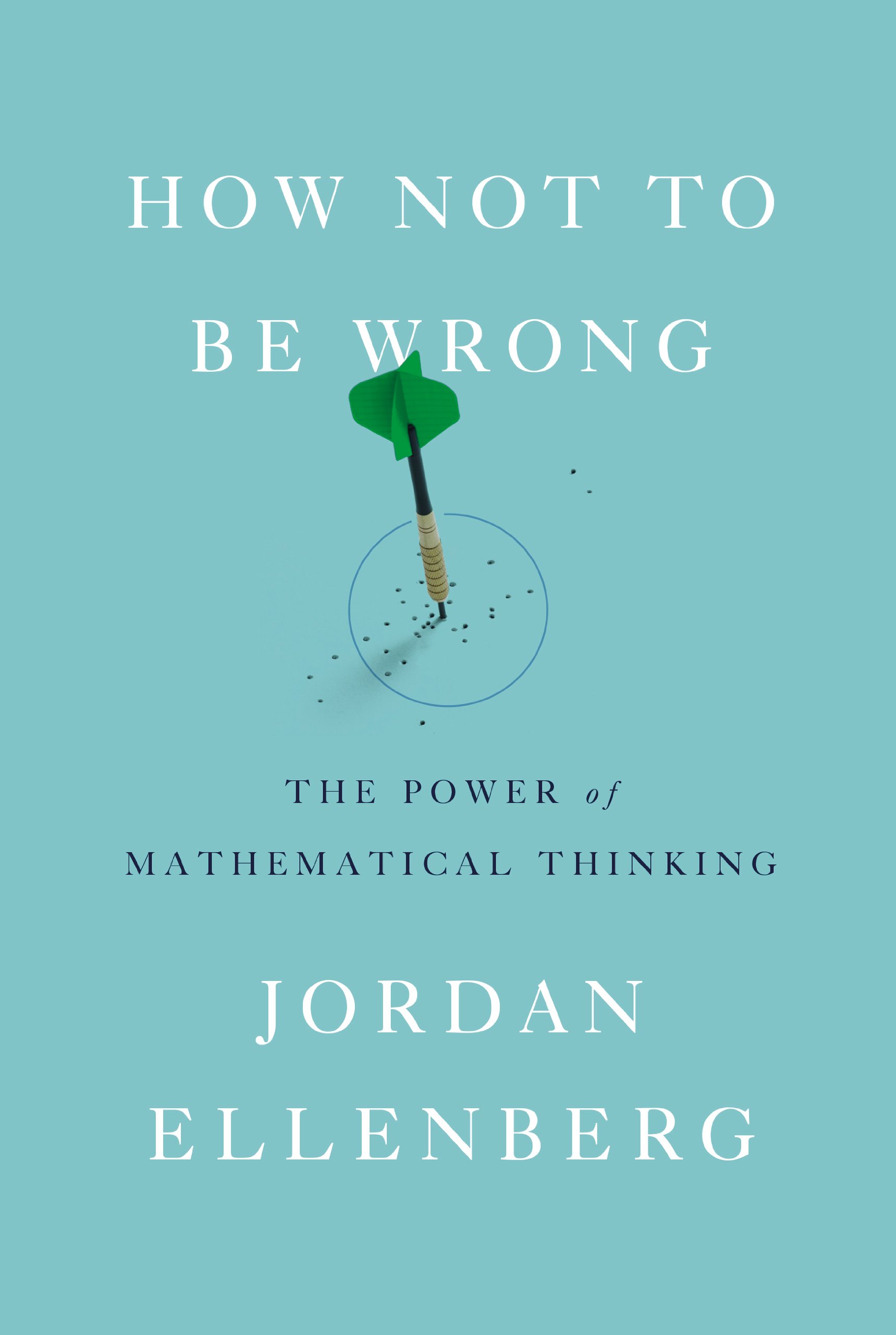
How to Not Be Wrong by Jordan Ellenberg


"I heard about it on NPR!" And what a fun read! Accessible to the layperson, this book tells and shows that math isn't just about passing a class in high school and then for a few select elites, but it is a way to look at the world so that things make sense, and it is for everyone.

I do admit there were a few chapters I didn't get into as much. But there were so many good ones! I found myself wishing this was required reading... in high school, or definitely in college for programs such as mine, where math is foundational but not the focus.

I enjoyed so many of the topics that Ellenberg illuminated, but these were my favorites:

1. how to teach math-- this was something of a soapbox tangent, but something I found myself wanting to give a hearty "amen" to. An excerpt from "An aside: how to get partial credit on my calculus exam."

"Working and integral of performing a linear regression is  something a computer can do quite effectively. Understanding whether the result makes sense--or deciding whether the method is the right one to use in the first place--requires a guiding human hand. When we teach mathematics we are supposed to be explaining how to be that guide. A math course that fails to do so is essentially training the student to be a very slow, buggy version of Microsoft Excel.
And let's be frank: that is really what many of our math courses are doing."

He goes on to explain that in the "math wars," some favor the "traditional" approach of memorizing algorithms, emphasizing arriving at the correct answer, while others emphasize approximation and meaning. To paraphrase, Ellenberg thinks both are necessary: students should memorize multiplication tables, AND be able to know at the end of a long calculus problem whether their answer makes sense (and why).

2. statistical significance (and lack of it)
First, see: https://xkcd.com/882/
"What if the green jelly bean were tested twnty times by twenty different research groups in twenty different labs? Nineteen of the labs found no sattistically significant effect. They didon't write up their results-- who's going to publish the bombshell "green jelly beans irrelevant to your complexion" paper? The scientists in the twentieth lab, the lucky ones, find ta statistically significant effect, because they got lucky--but they don't know they got lucky. For all they can tell, their green-jellybeans-cause-acne theory has been tested only once, and it passed" (152).
"This is the so-called file drawer problem--a scientific field has a drastically distorted view of the evidence for a hypothesis when public dissemination is cut off by a statistical significance threshold" (152).
Ellenberg explains the null hypothesis and its importance, and how it is often not considered during interpretation of research. We often don't consider the whole picture.

I found this especially illuminating in regard to my field: nursing is trying to become a profession more and more "evidence-based" and nursing journals are full of research. However, I am regularly astounded at how small sample sizes are, and the lack of replication of data I see before findings are turned into gold standards.

Ellenberg offers hope that more experts are realizing that change needs to happen, and says the APA is starting a new genre of articles that are studies attempting to replicate breakthrough findings, and they are "accepted for publication before the study is carried out. If the outcomes support the initial finding, great news, but if not, they're published anyway, so the whole community can know the full state of the evidence" (162).

3. eugenics--Ellenberg discusses great contributions to mathematics of Francis Galton, who also has been described as the father of eugenics. "What can I say? Mathematics is a way not to be wrong, but it isn't a way not to be wrong about everything... Wrongness is like original sin; we are born to is and it remains always with us, and constant vigilance is necessary if we mean to restrict its sphere of influence over our actions. There is real danger that, by strengthening our abilities to analyze some questions mathematically, we acquire a general confidence in our beliefs, which extends unjustifiably to those things we're still wrong about" (335).

4. public opinion majorities--"The 'majority rules' system is simple and elegant and feels fair, but it's at its best when deciding between just two options. Any more than two, and contradictions start to seep into the majority's preferences." Ellenberg gives the example of Obamacare. Interpretations of polls have declared "Majority of Americans oppose Obamacare!" and "Majority of Americans want to preserve or strengthn Obamacare!" and both are somewhat misleading. Ellenberg shows that both are incomplete, since there are really three groups of Americans--those who want to leave the law alone, those that want to kill it, and those who want to make it stronger. "And each of the three choices is opposed by most Americans."

Bahaha! So many things I will think about differently (and hopefully, less wrongly) in the future!

Wednesday, February 4, 2015

More by Alan Kraft

I couldn't even find a picture of this book. It's fairly new, written by the pastor of my late-college church, Christ Community in Greeley. I loved that church. I treasure his book Good New for those Trying Harder because it sums up so much of what God taught me during that time.

This one is a bit more challenging. Learning to be aware of, and invite, and surrender to, the Spirit. There is some theology behind it, and then lots of practical ideas for how to do it.

Mostly this just made me aware of how soundly lacking I am in my prayer life, and dependence on God in general. May it be the beginning of something new God is doing.

This is the one thing I highlighted, "We all instinctively know that sin thrives in secret. In the darkness of isolation our sins exert their greatest power" (page 169). What followed was one of many admonitions on the importance of having fellowship. There were even statements like, "This will never happen unless you have close friends to do it with you," (paraphrase) which are quite depressing to me, since that is another area that desperately needs help.