
Saturday, August 11, 2012
The Shunning by Beverly Lewis

Saturday, July 28, 2012
The Hunger Games by Suzanne Collins

Well, one of the first things I realized when reading the book was another theme that probably should have been obvious-- themes of the effects of violence, inequality, and poverty on the young.
One of the dilemmas this book has raised for me is the conflict between actions and intentions. One, the book reveals motivations behind many of the actions I saw in the movie, from Peeta throwing Katniss the bread, to Katniss' inconsistent behavior during training. The exploration of thoughts, feelings, and motivations ends up creating a completely different picture, also a more engrossing one (SO YAY BOOKS!) The other part of that, however, is: the book seems to yet again suggest that as long as one has good intentions, it is okay to do the wrong thing. In an ideal world, we would all do the right thing for the right reason. (I learned that lesson a long time ago.) In what circumstances should we compromise that?? What if you can't have both??
At first exposure, in the situation Collins presents, we don't even question Katniss taking for granted that she would kill. I imagine that, if it were me, I would too. Then, I wonder is that right? I know this sounds crazy, but I'd like to apply 1 Corinthians 10:13 to this situation...... in everything, I want to trust God for a way of escape. (Easier said than done!)
So, back to comparing the book to the movie:
The book was better! I couldn't put it down! Hearing things from Katniss' perspective makes you understand why she did what she felt she had to do in her relationships. It also points out (thankgoodness) how despicable the idea of "hunger games" truly is. Furthermore, it made me want to read the next book....... aaaand halfway through "Catching Fire," I decided to read an online summary. I found out out that the ending doesn't conclude as neatly as I would like. I also find that darker books that focus on how messed up the world is without offering hope kind of bum me out. So I'm stopping there... but now I read it and I know what all the fuss is about :)
Saturday, June 23, 2012
Quiet: the power of introverts in a world that can't stop talking by Susan Cain

At times, it felt Cain was proposing that introverts are better than other people, but now I think that really, her perspective is just so counter-cultural, it sounds off-putting at first . I was hardly aware of "the extrovert ideal" in our culture until I read this, but I definitely agree it's there. From viewing shyness in children as a problem to be fixed, to granting promotions on the basis of gregariousness, our culture prefers extroverts-- even though introverts are often the deepest thinkers, and often make great leaders.
I found her discussions on the strengths of introverts very affirming: preferring quiet isn't a flaw. I appreciate her emphasizing that forcing individuals to go against their personality isn't harmful only to him/her, but also our whole society. Equally, I appreciate her acknowledgement that there are situations where one must go outside the realm of what comes naturally for the sake of "core personal projects." For example, it can be hard for extroverts to sit and study, or hard for an introvert to talk to a crowd of people, but for something one believes is important, it is worth it.
I was particularly intrigued by her (brief) observations about the evangelical church's preference for extroverts, and how this influences its introverts. I can't wait to read the book she recommended, Introverts in the Church.
Also, I noticed this and thought... maybe a reflection of our culture's preference for extroversion?? How google defines introverts:
| Noun: |
|
Introversion (I)
I like getting my energy from dealing with the ideas, pictures, memories, and reactions that are inside my head, in my inner world. I often prefer doing things alone or with one or two people I feel comfortable with. I take time to reflect so that I have a clear idea of what I’ll be doing when I decide to act. Ideas are almost solid things for me. Sometimes I like the idea of something better than the real thing.
The following statements generally apply to me:
- I am seen as “reflective” or “reserved.”
- I feel comfortable being alone and like things I can do on my own.
- I prefer to know just a few people well.
- I sometimes spend too much time reflecting and don’t move into action quickly enough.
- I sometimes forget to check with the outside world to see if my ideas really fit the experience.
Hmm.
Monday, April 16, 2012
Fresh Movie
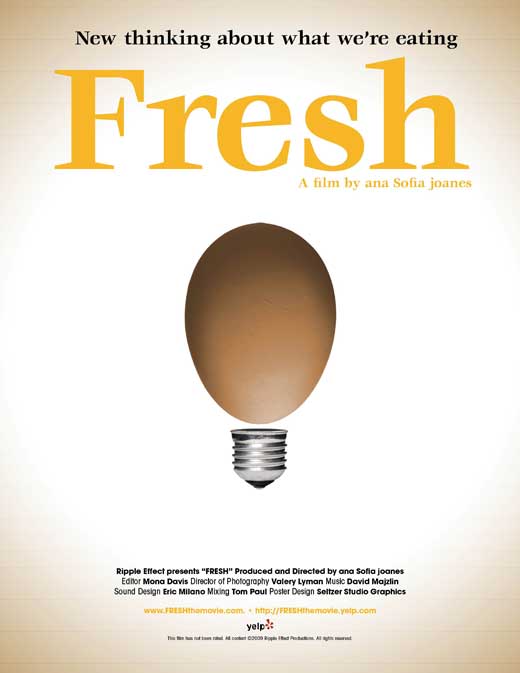
Enjoyed this documentary about food. I'm glad that there is such a movement toward caring about where our food comes from, and about how our choices impact our health and so much more. Of course, after these bursts of education, I wonder, what do I do now?
One back-to-basics farmer is portrayed in sharp contrast to the meat-factory and says:
“Where we’re standing got grazed 2 or 3 times in the Spring then we made hay on it; the next time it got grazed, ran the hen-mobile behind it; then we ran a big batch of turkeys through here….and then graze it again at wintertime; the point being that when you add all of those things up, suddenly you’re not getting not only the multi-speciatian, and the different kinds of manures, but you’re getting all these complimentary income streams, so that unlike the neighbor who just brought in beef cows getting $150/acre, we’re getting over $3000/acre/year, and we haven’t bought a seed, or bought an ounce of fertilizer in 50 years. That’s what I say, wow.”
Once expert says:
“It is true that local and organic food costs more. It’s worth more too. When this dozen eggs costs $4 or $5, because these animals have been on pasture, and it’s full of Omega-3 and it’s full of Vitamin A, those are not the same as those 79 cent battery-cage eggs. Yeah they’re a white sphere, but it’s not the same product. As we’ve industrialized our food we’ve made it cheaper, but we’ve also diminished it nutritionally. According to the USDA’s own numbers, if you look at fresh produce grown in 1950 and compare nutritionally with fresh produce grown today, you will find that the amount of key nutrients-- minerals, vitamins-- has diminished by 40%.”
“The more you process food, the less nutritious it is. Cheap food is an illusion. There is no such thing as cheap food. The real cost of the food is paid somewhere. And if it isn’t paid at the cash register, it’s charged to the environment, it’s charged to the public person in the form of subsidies, and it’s charged to your health. You do get what you pay for, with food as with anything else. There are people, however, who can’t afford it. And we need to basically level the playing field. Right now we’re heavily subsidizing every calorie of high-fructose corn syrup and hydrogenated oil, which are the building blocks of processed food, the least healthy food we’re eating, and we’re not doing anything to subsidize or support the growing of fresh produce. Millions of Americans live in food deserts, where you can’t find fresh produce; you can only find processed food. You can find Ramen noodles, but you can’t find an apple. People do want to eat this food, they just don’t have access to it.”
Freakonomics by Steven Levitt and Stephen Dubner
Thoroughly interesting... does make you ask a lot of questions!
Thursday, April 5, 2012
Heaven is for Real by Todd Burpo

I appreciate the simplicity and humility with which the story is told. I'm glad they decided to write this book, and that I heard about it, because to me, it is a reminder of what I claim to believe-- that heaven is for real! I was particularly touched by the little boy saying that he came back because Jesus was answering his dad's prayer. Oh, if I could remember every minute that heaven is real and that it is the home of a real God who really does answer prayers... and this story nudged me that direction.
Friday, March 30, 2012
Rocket Boys by Homer Hickam Junior

Yeah, the book was way better than the movie:)
Very interesting to me that they called the movie October Sky because market research showed woman under 30 wouldn't be interested in a movie called "Rocket Boys." So, they re-arranged the letters to create October Sky!
Aside from the part where it seemed like he was bragging about having sex as a teen, it was thoroughly enjoyable and inspiring story!
Subscribe to:
Posts (Atom)